Talc Mesh Size and Particle Size: How to Specify Talc Powder
Mesh numbers describe sieve openings, but fine talc powders are better specified by particle size distribution. This guide explains mesh-to-micron conversion, where the standard sieve series ends, and what to put in a talc enquiry.
Short answer
A mesh number tells you the opening of a test sieve: 200 mesh is 75 µm and 325 mesh is 45 µm under ASTM E11. The standard woven-wire series stops at No. 635 (20 µm), so finer talc grades are usually specified by a particle size distribution — for example D50 and D97 measured by laser diffraction — or by the residue left on a named sieve.
What "mesh" means
A mesh number counts the openings per linear inch of a sieve cloth. The higher the number, the smaller the opening. When a talc powder is described as "325 mesh", it normally means most of the powder passes a No. 325 sieve — but how much must pass, and how it is tested, should be written into the specification.
Mesh to micron conversion (ASTM E11)
| Sieve designation | Nominal opening |
|---|---|
| No. 60 | 250 µm |
| No. 100 | 150 µm |
| No. 200 | 75 µm |
| No. 325 | 45 µm |
| No. 400 | 38 µm |
| No. 500 | 25 µm |
| No. 635 | 20 µm |
These are the nominal openings of standard test sieves. A powder with 99% passing 325 mesh can still contain particles much finer than 45 µm; the mesh figure only sets an upper limit.
Mesh numbers above 635
In the minerals trade you will see grades described as 800, 1250 or 2500 mesh. These numbers are trade designations for very fine powders, not standard test sieves — there is no woven-wire test sieve in the ASTM E11 series beyond No. 635. Different suppliers may use the same "mesh" name for powders that measure differently.
For fine grades it is more reliable to agree:
- D50 — the median particle size (half of the powder by volume is finer).
- D97 or D98 — the "top cut": 97% or 98% of the powder is finer than this size.
- The method — usually laser diffraction to ISO 13320, with the dispersion conditions stated, because results depend on the instrument and sample preparation.
Sieve residue: a simple, practical check
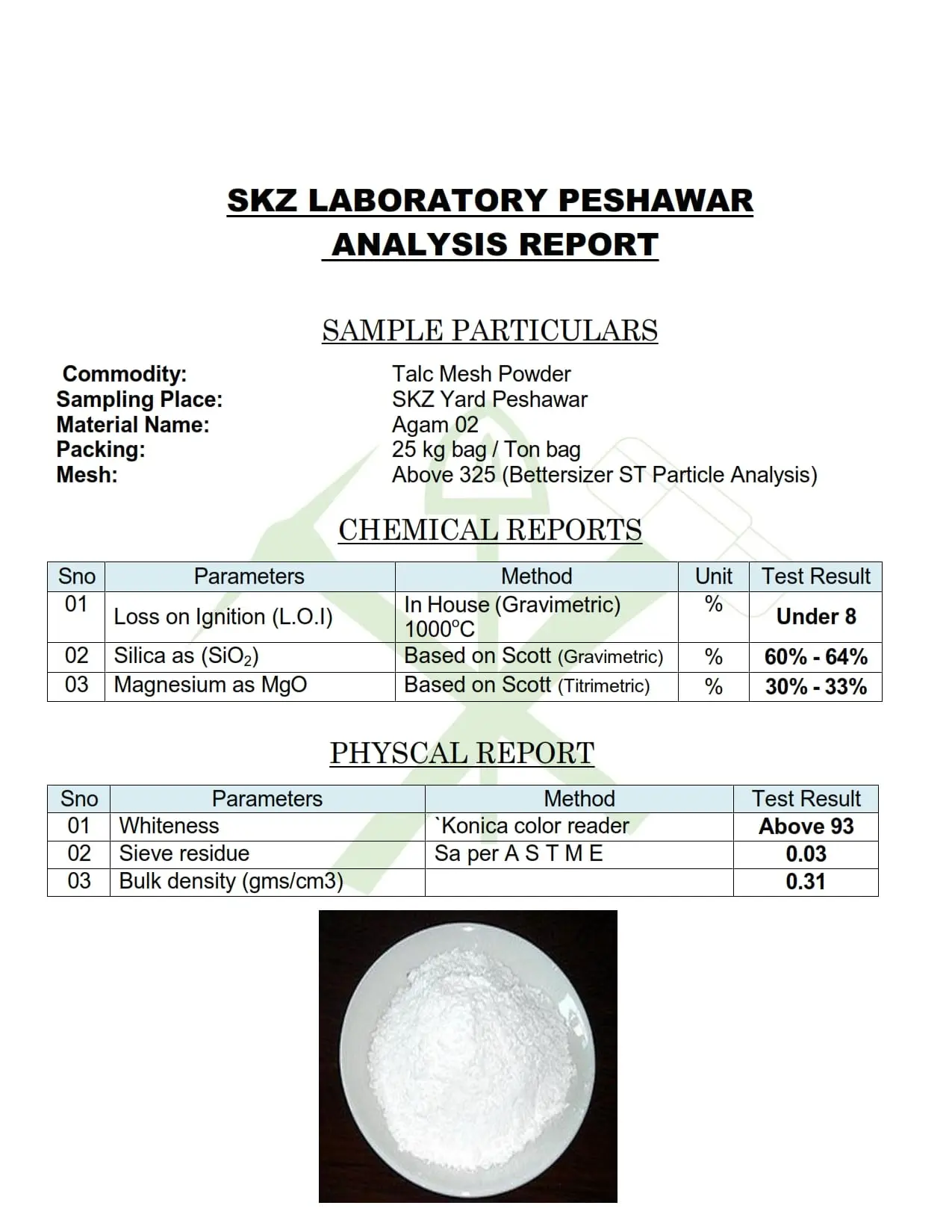
Many specifications include a maximum residue on a sieve — for example "residue on 325 mesh: 0.5% maximum". It is quick to test and useful for catching oversize particles, which matter in thin films, coatings and fine mouldings. SKZ's laboratory reports for talc include sieve residue alongside other parameters.
What else to include in a talc specification
Particle size is only one part. For most industrial uses, buyers also specify:
- Whiteness or brightness and the measurement method.
- Loss on ignition (LOI), which reflects moisture and carbonate content.
- Chemistry — typically SiO₂ and MgO content.
- Bulk density, which affects handling and dosing.
- Moisture and packing (for example 25 kg bags or ton bags).
- Application — the right grade for polypropylene compounds is not necessarily the right grade for paint or ceramics.
If a regulated use is intended (cosmetics, pharmaceuticals or food contact), say so at the start and state the tests your market requires, including asbestos testing methods. See our talc product page for how SKZ handles these requests.
How SKZ grinds and tests talc
SKZ's two meshing plants in the Hayatabad Industrial Zone, Peshawar, grind talc across a range the company describes as 250–2500 mesh, using hammer and Raymond mills. The SKZ laboratory in Peshawar tests whiteness, loss on ignition, silica and magnesium oxide content, sieve residue, bulk density and particle size. Representative values for named grades and two laboratory reports are published on the talc page.
When you request a quote, give the particle size in the form you test it — mesh with a passing percentage, residue on a named sieve, or D50/D97 by laser diffraction — so the offer can be matched to your method.
Sources
- ASTM E11, Standard Specification for Woven Wire Test Sieve Cloth and Test Sieves — sieve designations and nominal openings, as tabulated by Gilson Company.
- ISO 13320:2020, Particle size analysis — Laser diffraction methods.
- SKZ Mining Company: plant, milling range and laboratory parameters (company information and SKZ Laboratory reports).