COA, TDS and SDS: What Mineral Buyers Should Ask For
A certificate of analysis, a technical data sheet and a safety data sheet answer different questions. This note explains each one and what SKZ can provide with a mineral order.
Short answer
Ask for a certificate of analysis (COA) when you need the measured results for the lot you will receive. Ask for a technical data sheet (TDS) when you need the typical specification used to compare grades. Ask for a safety data sheet (SDS) when you need hazard, handling and transport information. They are not interchangeable, and a supplier should not treat a typical data sheet as the test result for your shipment.
Certificate of analysis
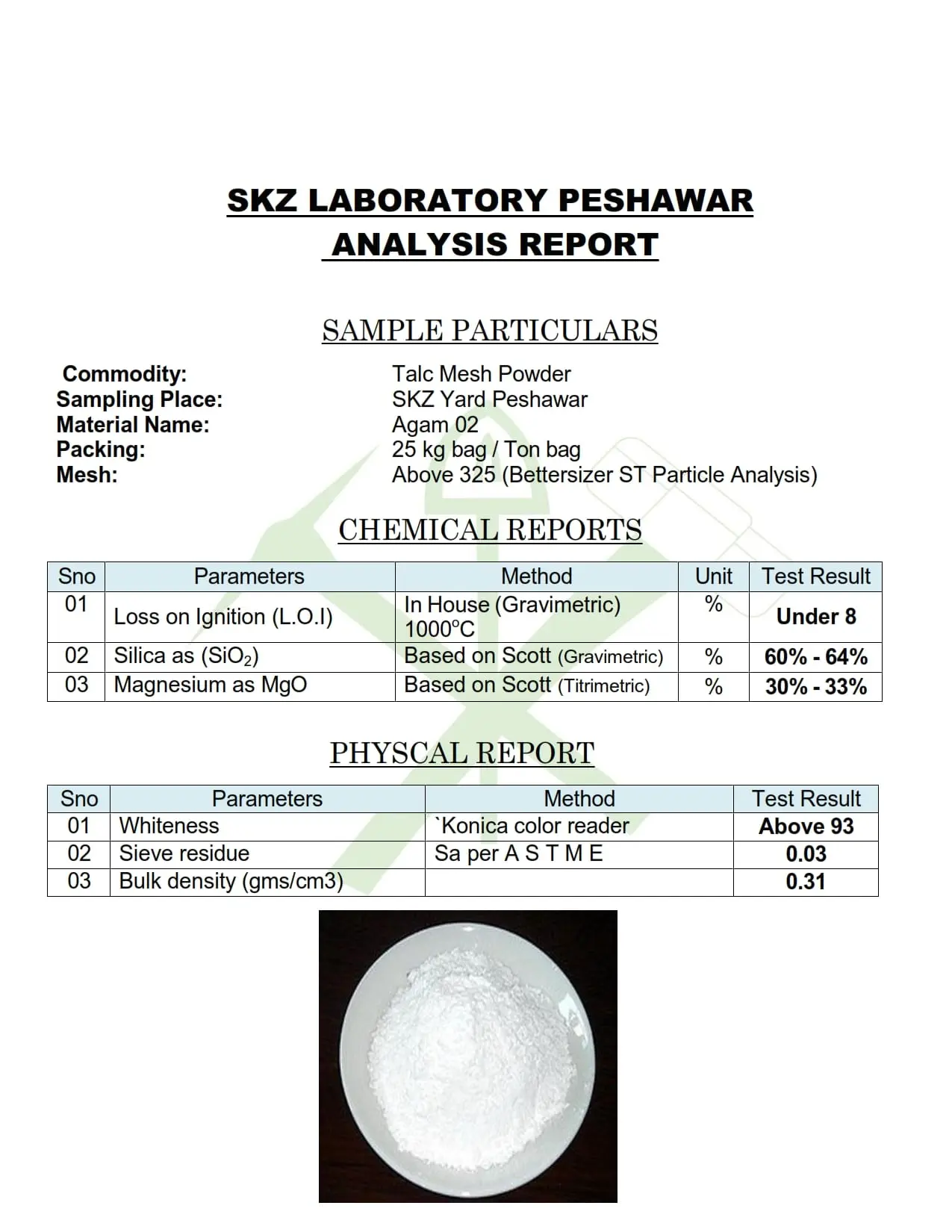
A COA reports tests on a defined sample: the lot, batch or shipment it belongs to, the method where that matters, and the result. For an industrial mineral that often means particle size or sieve residue, moisture, chemistry and colour, written against the limits you agreed.
SKZ's laboratory in Peshawar issues analysis reports for talc. Two sample reports, for grades Agam 02 and DD, are published on the talc page. Those pages are examples of how a lot is reported. They are not a promise that every future lot will match those figures. When you order, ask for the analysis of the lot being offered.
Technical data sheet
A TDS describes a grade in general: typical chemistry, a usual particle-size range, packing and the applications it is sold for. It is the right document for an initial comparison. It is the wrong document to use as evidence that a particular container met the specification.
SKZ publishes representative talc values on the talc page and labels them as representative, not as a guarantee for every lot. Calcium carbonate, dolomite and industrial salt are quoted against your specification instead. We do not publish a fixed public data sheet for those minerals, because no current SKZ specification document is on file for them.
Safety data sheet
An SDS describes hazards, composition for safety purposes, handling, storage and transport. It does not prove that a lot met a particle-size or purity specification. If your carrier, warehouse or customer requires an SDS, say so in the enquiry and name the regulation your market uses. SKZ does not claim a particular hazard classification on this website.
What to write in the enquiry
1. The mineral and the grade or end use. 2. The document you need: COA for the lot, TDS for the grade, SDS, or more than one. 3. The properties that must appear (for example sieve residue, D50, moisture, CaCO₃, MgO, whiteness). 4. Whether a third-party laboratory must sign the report. 5. The destination country, because import paperwork is not the same everywhere.
Send that list with the quote request. If the document you need is not available for that product, we will say so before you order rather than substitute a different kind of sheet.